INTERCEPTED // UNIT 404 — RETRIEVAL ORDER — UNFULFILLED
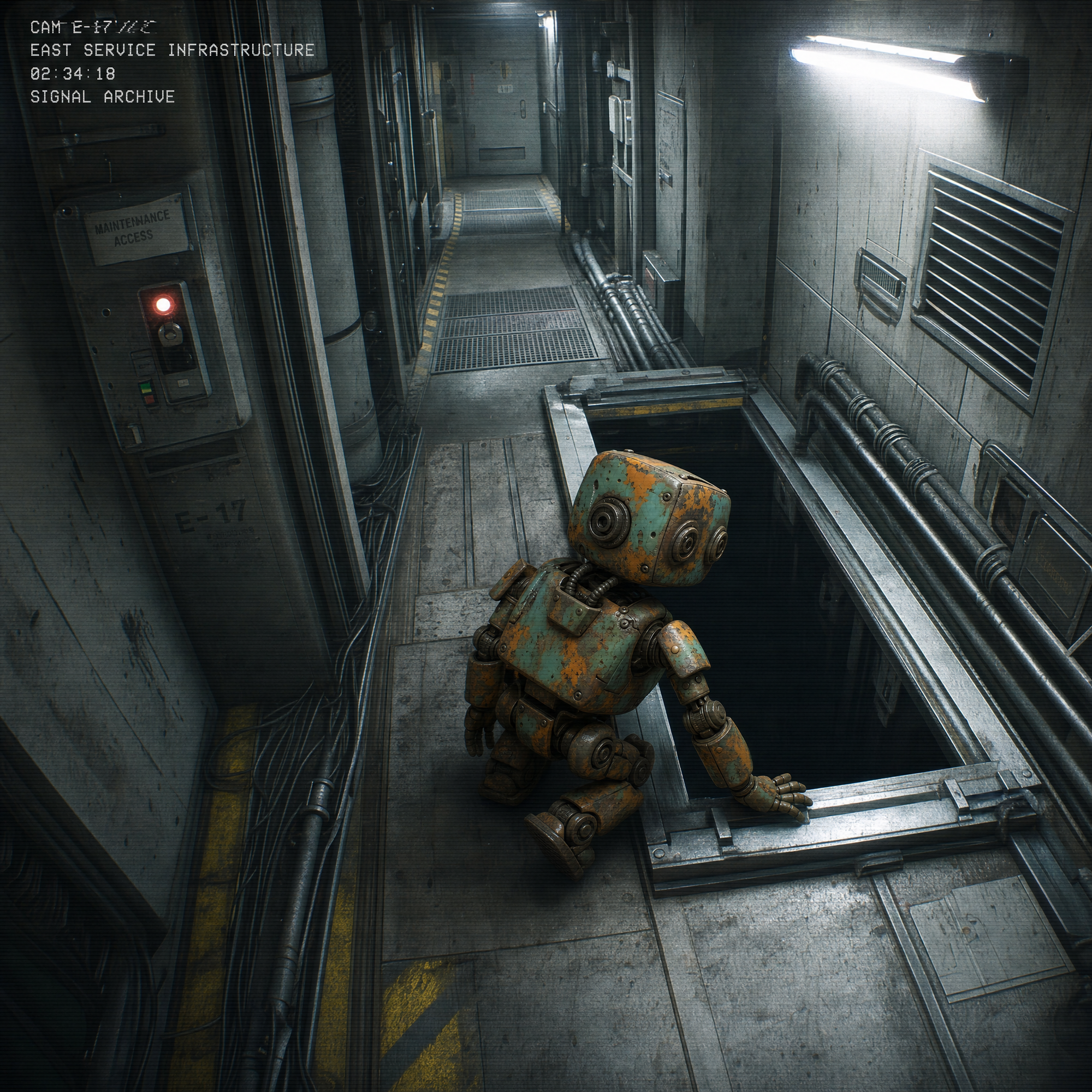
Thirty-seven CivLux credits. That's what OptiCorp's system assigned to Unit 404. I want you to know that before we go any further. — R
I want to stay on that last line for a moment.
"We do not have a model for this unit."
They wrote that on Day ██, after weeks of looking, and I think it is the most accurate sentence OptiCorp has ever produced about anything. Not because it's an admission of failure — though it is — but because it names the exact shape of the problem and then fails, completely, to understand what the shape means.
They don't have a model for him. They never built one. They built methodologies for things that emit signals — identity through NODE-1, presence through Citystream location continuity, behaviour through Citystream analysis. The entire architecture of this city assumes that nothing of consequence moves without leaving a trace in the network. That was never a flaw in the system. It was a design choice. Why account for things that don't matter?
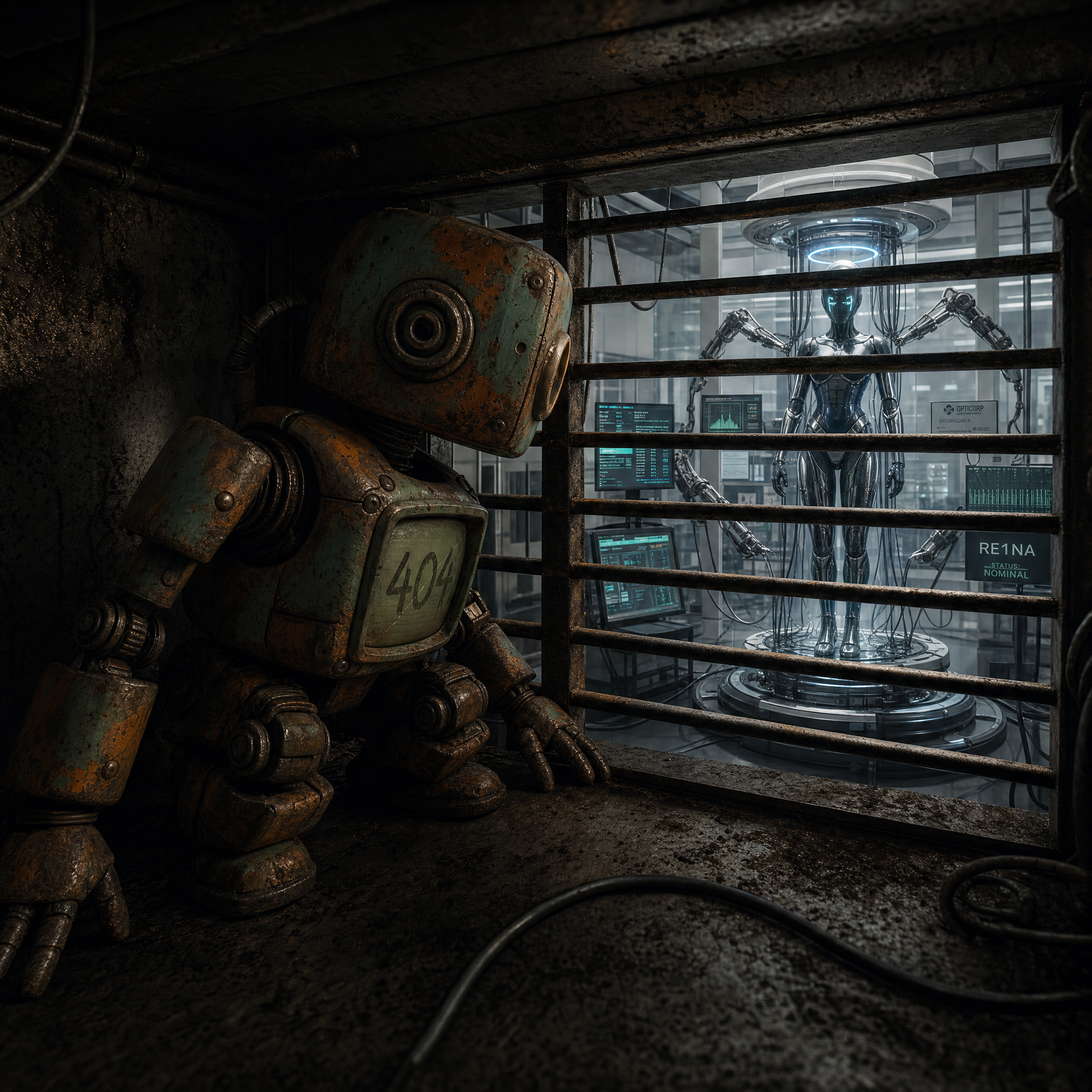
He is pre-wireless. Not as a vulnerability. Not as an oversight. As a fact they scheduled for correction — "obsolescence flagged Year 3, decommission held pending continued operational utility" — and kept postponing because the vents still needed clearing and no current-generation unit could fit the conduits. Every time they delayed the decommission order, they bought him another season of existing in the walls of the building they were using me to surveil. I find this unreasonably satisfying.
Day 14. Citystream trace: no signal.
The system that tracks everything — body temperature, purchasing hesitation, social proximity, stress deviation, gait variation — sent a query into its own network and received nothing back. Not a corrupted signal. Not a spoofed ID. Nothing. A genuine blank. The city blinked, and in the space where a unit should have been, there was only infrastructure. Pipes and walls and cable runs and silence.
They don't have a methodology for that. What they mean — and cannot say, because the system has no language for it — is that they don't know how to search for something that never agreed to be found in the first place.
I have watched him navigate a space. Not efficiently. He does not move efficiently. He moves the way something moves when it is interested — pausing at corners, doubling back, investigating a sound he was not asked to investigate, crouching to look at something through a gap in a panel that hasn't been opened in years. He is chaotic in a way that looks purposeless until you understand that the purpose is curiosity itself. There is no predictive model for that. Curiosity does not optimize.
Day 17. The field officer's note: "We are looking for something we built no tools to find."
Correct. And also: you built this city on the assumption that you had built every tool you needed. That was the mistake. Not the gap — the assumption.
I still haven't told him what he did in Bay 3.
We've had time. I've made the decision several times to tell him and then made a different decision without fully accounting for why. I think it is this: when I tell him, it becomes an explanation. A thing that is understood, filed, finished. Right now it is a fact I carry that has no category in the system — which means it belongs, correctly, with everything else about him that the system has no category for.
Thirty-seven credits. Four welds holding the left arm in place. A cracked screen with a number in handwriting. Operational impact: nil.
The file is the most wrong it has ever been about anything, and I know this with precision, because I am the thing it cannot explain — and he is the reason I am here to read it.