WHEN THE HALO SCOUTS LEAVE
SOURCE · UNVERIFIED CIVILIAN SUBMISSION
RECEIVED · ULTRA INTERCEPT NODE 7B
DISTRIBUTION · RESTRICTED
You notice the quiet first.
Not silence exactly. Cinderport is never silent. There is always ventilation somewhere. Traffic. Delivery drones. Metro vibration under the concrete. Citystream voices leaking out of wall panels and doorway speakers, telling people to mind the gap, hydrate, re-route, confirm identity, enjoy the Core.
But there is a kind of quiet that happens before Xoptic arrives.
The Halo Scouts leave.
That is what I noticed.
There were three of them above North Relay Walk, moving their usual slow circles over the pedestrian lanes. The small ones. White housings, soft public lights, all that harmless “civic safety” theatre. They were watching the queue outside the transit kiosk and the food vendors by the corner. Nothing unusual. Nothing worth remembering.
Then one by one, they lifted out.
No announcement. No warning. No polite Citystream voice telling anyone to clear the area.
They just left.
The first went north over the service roof. The second dipped behind the transit screens. The last one hovered for a few seconds above the crosswalk, then snapped upward hard enough that people looked up from their phones.
That was when everyone understood something had already been decided.
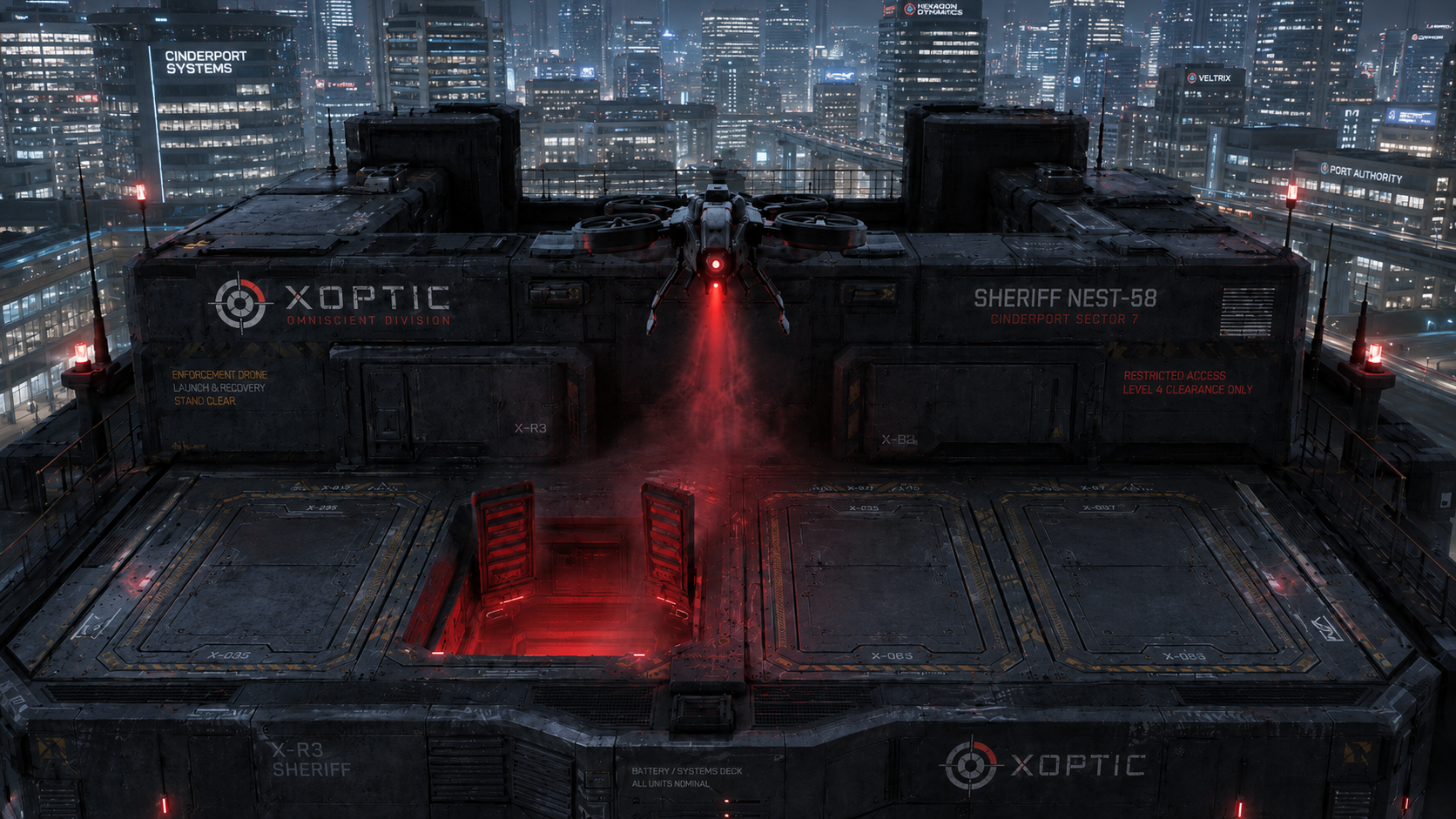
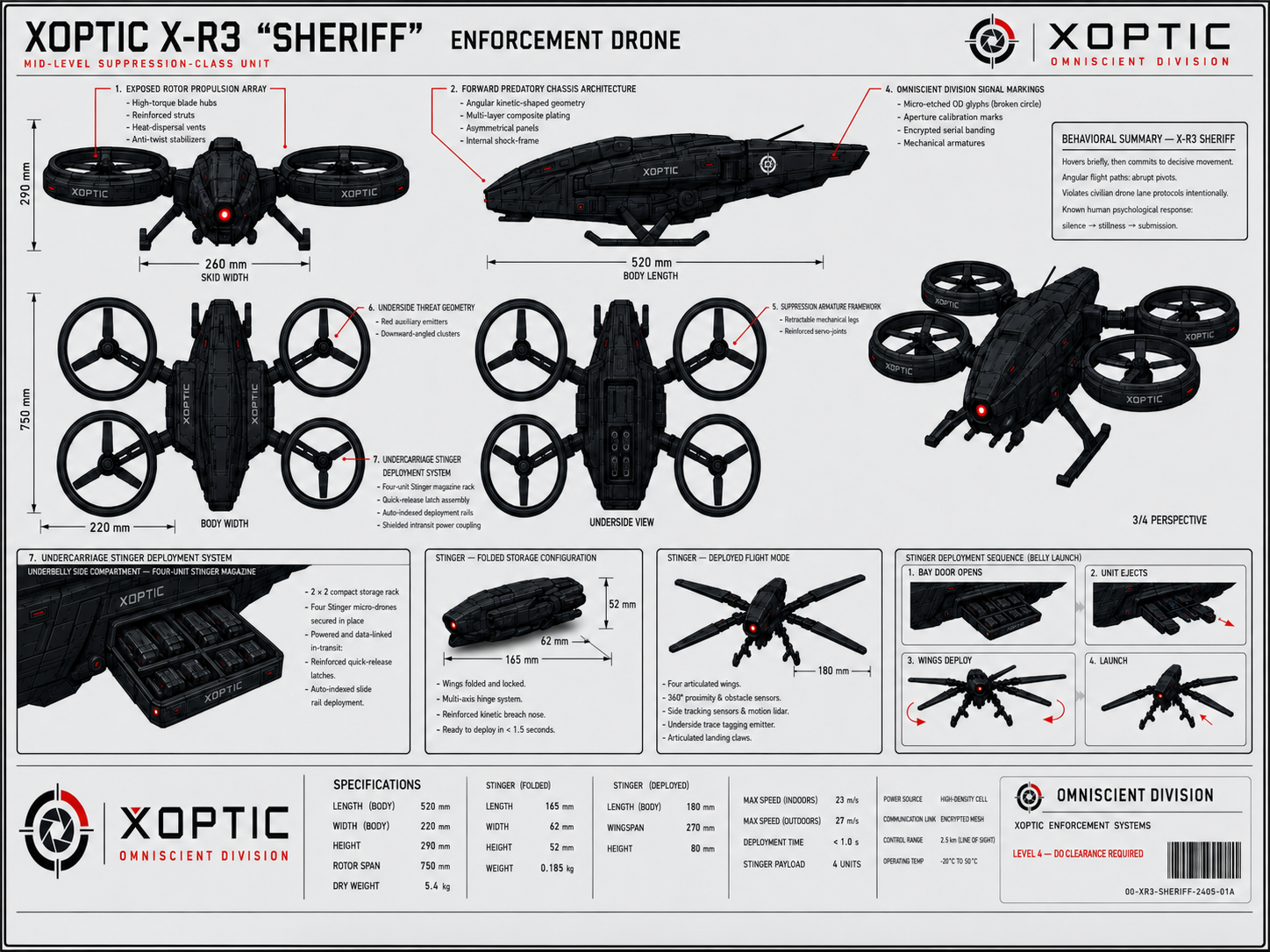
A Sheriff came in low from the east.
You feel those before you hear them properly. The air shifts. The street changes its posture. People stop crossing halfway through the road even when the walk signal is still on. Conversations break in the middle of sentences. Nobody wants to be the loudest person when an X-R3 is overhead.
It moved like the videos say they move. Not like a normal drone. Not smooth. Not civilian. It held position for half a second, then cut sideways in a hard pivot. It did not drift. It corrected.
There were two men near the side entrance of the old municipal stairwell. Early thirties maybe. Work jackets. One had a takeaway tray in his hand. The other kept checking his phone like it had already done something he didn’t like.
The Sheriff did not speak.
That was the worst part.
People think the worst part would be the red light, or the rotors, or the way the camera holds on you like it knows what you meant before you did it. It isn’t. The worst part is that there is no argument. No “citizen, remain still.” No explanation. No chance to perform innocence for the crowd.
The red optic fixed on the man with the phone.
A thin beam touched his chest.
That was it.
His phone lit red immediately.
Everyone nearby saw the glow through his fingers.
He had been tagged.
There are levels to these things. Everyone in Cinderport knows that, even if nobody admits how much they know.
If your phone pings without a Sheriff deployment, if Citystream flags you for suspicious behaviour, pattern drift, proximity concerns, withheld compliance, whatever language they dress it in that week, you usually get three hours to report to a Civic Review Centre.
Three hours.
Enough time to finish work if your supervisor allows it. Enough time to call your partner. Enough time to panic properly. Enough time for Citystream to keep reminding you that voluntary reporting preserves civic standing.
But a Sheriff tag is different.
A Sheriff tag gives you one hour.
One hour before Xoptic deploys.
Not a message. Not a reminder. Deployment.
Everyone knows that too.
The tagged man froze. His friend didn’t.
His friend bolted through the stairwell door.
It was a stupid thing to do, which is easy to say from across the street when you are not the one being watched by a machine that just turned your whole life into a countdown. He shoved the door open with his shoulder and disappeared inside. The door bounced once against the frame.
For a second, the Sheriff stayed where it was.
Then the underside opened.
I had never seen that before.
A section of the drone’s belly shifted outward, not from the rotors, not from the arms, from the chassis itself. A side-underbelly compartment. Clean. Mechanical. Like something designed by people who hate hesitation.
Something small dropped from it.
At first I thought it was debris.
Then it unfolded.
Four thin wings snapped out, two on each side. Not rotors. Wings. Like a dragonfly made by a defence contractor. Black body, red optic, narrow head. It hung under the Sheriff for less than a second.
Then it hit the stairwell window.
It did not slow down.
The glass went all at once.
Not a crack. Not a spiderweb. A flat, sharp burst inward, and the Stinger was through it before the pieces had finished falling.
The sound reached us after the movement.
That is what I remember most. The delay. Seeing it happen, then hearing the building admit it.
People stepped back from the pavement. A woman near the kiosk put both hands over her child’s ears, too late. The tagged man stood there with his phone glowing red against his palm, looking at the broken stairwell window like he was watching his own future climb inside after his friend.
The Sheriff remained outside.
Waiting.
No crowd control. No broadcast. No command. Just the red optic and that awful controlled hover.
A few moments passed.
Maybe less. Maybe more. Time gets strange when everyone is pretending not to watch.
Then the stairwell door opened again.
The friend came out first.
Slowly.
He had both hands raised, but there was no human officer there to see it. His phone was glowing red too. The Stinger came after him, hovering just behind his shoulder, close enough that he didn’t turn his head.
The first man looked at him.
Neither of them said anything.
Their phones pulsed in sync.
Citystream must have sent the route because both screens changed at the same time. Same red-white notice. Same arrow. Same instruction.
Report to the nearest Civic Review Centre.
They walked.
Not fast. Not slow. The way people walk when they are trying not to attract further attention from a system that has already noticed everything.
The Sheriff followed above them for half a block, then peeled away.
The Stinger folded mid-air and returned to the underbelly bay.
By the time the Halo Scouts came back, the glass had already been swept into the gutter by one of the street cleaners.
The kiosk reopened.
The walk signal changed.
A Citystream panel nearby flashed a service message about minor disruption on North Relay Walk and reminded residents that calm cooperation supports community wellbeing.
Nobody mentioned the stairwell.
Nobody mentioned the one-hour rule.
Nobody mentioned that the difference between a warning and a deployment is how quickly the city decides you are no longer expected to choose.
They call the Civic Review Centres by their proper name on the signs.
Clean letters. White walls. Blue guidance strips. Friendly appointment windows.
But everybody else calls them the Hopper.
Because once the system has already decided why you are there, the hearing is just part of the machinery.
The two men turned the corner toward South Processing.
Their phones kept glowing.
And the rest of us went back to pretending we had somewhere else to look.