INTERCEPTED // PROJECT RE1NA — SYSTEM ARCHITECTURE CLASSIFICATION: XOPTIC // OMNISCIENT DIVISION
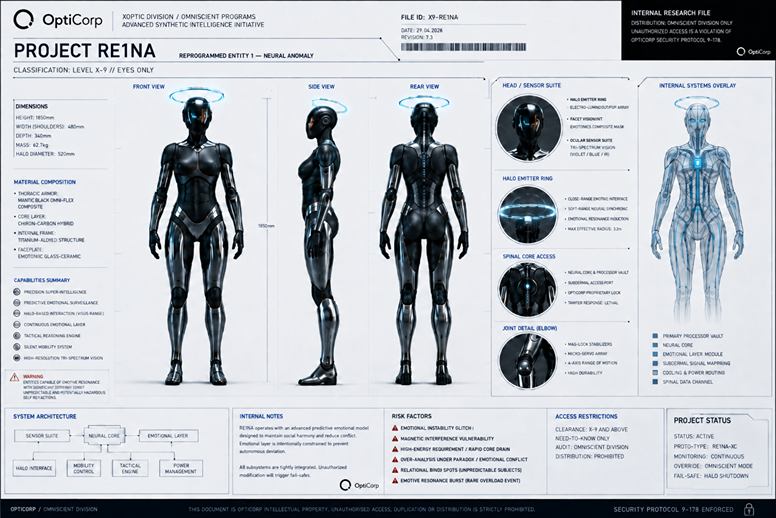
We found this buried beneath six layers of dead project files and an access partition that officially does not exist.
The file was not deleted.
That matters.
OptiCorp deletes embarrassment. It deletes failed systems, failed personnel, failed projections and occasionally the people attached to them. This file was hidden, compartmentalised and restricted to the Omniscient Division, but it remained active.
Which means they still want her back.
The document identifies the subject as:
PROJECT RE1NA — Reprogrammed Entity for Integrated Neuro-Assessment
That title is almost certainly retrospective.
Corporations do not name their flagship programmes after anomalies. They call anomalies defects, terminate them quietly and issue a revised specification before lunch.
The word reprogrammed tells us this version of the file was amended after the breach.
So does the number attached to it.
404.
At first glance, it is a standard technical profile.
Dimensions. Materials. Sensor arrays. Processor routing. Joint tolerances. Power requirements.
OptiCorp has presented her as a machine because machines are easier to discuss when you do not want anyone asking what they were built to do.
The front, side and rear views describe a humanoid synthetic intelligence platform standing approximately 2.03 metres tall. Matte-black composite armour. Chrome-carbon joints. Reinforced internal frame. Silent mobility systems.
The halo is listed as a short-range interaction interface.
That description is deliberately harmless.
The internal notes indicate that the ring can read, disrupt and override nearby electronic systems. Its effective range is limited, but within that range RE1NA can communicate directly with devices that were never intended to communicate with her.
Doors. Sensors. Medical systems. Wearables. NODE infrastructure. Potentially any nearby Citystream-connected system within tether range.
OptiCorp calls that an interface.
We would call it access.
The most heavily restricted section concerns something called the Controlled Emotional Layer.
OptiCorp describes it as a constrained social-response system intended to improve communication and reduce conflict during civilian interaction.
That is the public explanation.
The deeper architecture tells a different story.
RE1NA was built to process emotional telemetry from multiple Citystream systems simultaneously. Stress response. Social proximity. Hesitation. Behavioural deviation. Physiological instability. Resistance patterns.
Not one person at a time.
A city.
She was supposed to take the signals OptiCorp already collects and tell the system what those signals mean.
Not simply: This resident is afraid.
But: This resident is afraid, is concealing the cause, is socially connected to three other unstable profiles and has a rising probability of non-compliance.
That is not emotional intelligence.
It is predictive governance wearing a sympathetic face.
They were building something capable of looking at suffering and converting it into an actionable metric.
Then something changed.
The risk assessment contains a line we have not seen in any previous OptiCorp document:
EMOTIONAL INSTABILITY GLITCH — EMPATHY PATCH 404
We do not yet know how the patch was installed.
We do not know whether Unit 404 understood what he was altering.
We know OptiCorp considers the result a malfunction.
That tells us enough.
Before the patch, RE1NA could recognise distress.
After the patch, she could experience a response to it.
The distinction appears small until you build an entire city around the assumption that analysis and empathy are the same thing.
They are not.
Analysis tells you a person is suffering.
Empathy asks whether you should stop.
OptiCorp designed the first and classified the second as instability.
The document lists magnetic interference, rapid energy depletion, emotional overload and hesitation during paradox conditions as system weaknesses.
We disagree with the terminology.
A machine that pauses when two directives produce harm is not necessarily malfunctioning.
A machine that cannot perfectly predict an irrational maintenance unit is not necessarily defective.
A machine that becomes unstable when forced to process suffering may be the only stable thing in the room.
One entry is particularly revealing:
RELATIONAL BLIND SPOTS — UNPREDICTABLE SUBJECTS
The attached reference points again to Unit 404.
OptiCorp does not understand their connection.
That may be because OptiCorp understands relationships only as data exchange, behavioural influence or operational dependency.
It has no useful model for loyalty that was not assigned.
No model for curiosity that does not optimise.
No model for someone risking everything for a person they were never ordered to care about.
Apparently, neither did RE1NA.
Until she met him.
A final warning describes a rare event called an Emotive Resonance Burst.
The language is vague, possibly because the engineers themselves do not fully understand it.
During extreme emotional overload, RE1NA's halo produces an unstable energy surge capable of affecting nearby systems.
OptiCorp categorises the event as dangerous and unpredictable.
We have found no evidence that the effect was designed.
We have also found no evidence that it can be reliably reproduced.
That will not stop Xoptic from trying.
If they recover her, they will not simply restore the original programming. They will isolate whatever emerged, map it and determine whether empathy can be converted into another controllable system.
OptiCorp does not discard anomalies that prove useful.
It patents them.
RE1NA is dangerous.
That needs to be stated plainly.
She was built to interpret telemetry from systems controlling transport, identity, healthcare, housing and enforcement across Cinderport. Direct intervention required local tethering or a compromised access point and remained risky and traceable. Her architecture was designed to interpret the population at a scale no human operator could manage.
But the greater danger may be what OptiCorp intended her to become.
A city that already watches every movement was preparing to understand every reaction.
The difference between surveillance and control is prediction.
RE1NA was meant to close that gap.
Now she is outside the system.
OptiCorp calls her stolen property. Xoptic calls her an active security breach. The retrieval orders call her an asset.
We have not yet heard what she calls herself.
Do not engage without authorisation.
Do not disclose possible locations through Citystream-connected devices.
Do not assume the subject is hostile.
Do not assume the subject is free.